Saturday, May 26, 2012

Galaxy


A galaxy is a massive, gravitationally bound system that consists of stars and stellar remnants, an interstellar medium of gas and dust, and an important but poorly understood component tentatively dubbed dark matter. The word galaxy is derived from the Greek galaxias(γαλαξίας), literally "milky", a reference to the Milky Way galaxy. Examples of galaxies range from dwarfs with as few as ten million (107) stars to giants with a hundred trillion (1014) stars, each orbiting their galaxy's own center of mass.
Galaxies contain varying amounts of star systems, star clusters and types of interstellar clouds. In between these objects is a sparseinterstellar medium of gas, dust, and cosmic rays. Dark matter appears to account for around 90% of the mass of most galaxies. Observational data suggests that supermassive black holes may exist at the center of many, if not all, galaxies. They are thought to be the primary driver of active galactic nuclei found at the core of some galaxies. The Milky Way galaxy appears to harbor at least one such object.
Galaxies have been historically categorized according to their apparent shape; usually referred to as their visual morphology. A common form is the elliptical galaxy, which has an ellipse-shaped light profile. Spiral galaxies are disk-shaped with dusty, curving arms. Those with irregular or unusual shapes are known as irregular galaxies and typically originate from disruption by the gravitational pull of neighboring galaxies. Such interactions between nearby galaxies, which may ultimately result in a merging, sometimes induce significantly increased incidents of star formation leading to starburst galaxies. Smaller galaxies lacking a coherent structure are referred to as irregular galaxies.
There are probably more than 170 billion (1.7 × 10¹¹) galaxies in the observable universe. Most are 1,000 to 100,000 parsecs in diameter and usually separated by distances on the order of millions of parsecs (or megaparsecs). Intergalactic space (the space between galaxies) is filled with a tenuous gas of an average density less than one atom per cubic meter. The majority of galaxies are organized into a hierarchy of associations known as groups and clusters, which, in turn usually form larger superclusters. At the largest scale, these associations are generally arranged into sheets and filaments, which are surrounded by immensevoids.


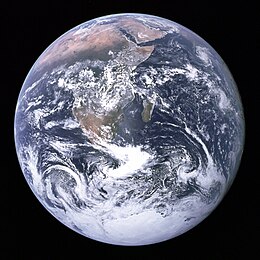
The Earth


Earth (or the Earth) is the third planet from the Sun, and the densest and fifth-largest of the eight planets in the Solar System. It is also the largest of the Solar System's four terrestrial planets. It is sometimes referred to as the world, the Blue Planet, or by its Latin name,Terra.
Earth formed approximately 4.54 billion years ago by accretion from the solar nebula, and life appeared on its surface within one billion years. The planet is home to millions of species, including humans. Earth's biosphere has significantly altered the atmosphere and otherabiotic conditions on the planet, enabling the proliferation of aerobic organisms as well as the formation of the ozone layer which, together withEarth's magnetic field, blocks harmful solar radiation, permitting life on land. The physical properties of the Earth, as well as its geologicalhistory and orbit, have allowed life to persist. The planet is expected to continue supporting life for another 500 million to 2.3 billionyears.
Earth's crust is divided into several rigid segments, or tectonic plates, that migrate across the surface over periods of many millions of years. About 71% of the surface is covered by salt water oceans, with the remainder consisting of continents and islands which together have many lakes and other sources of water that contribute to the hydrosphere. Earth's poles are mostly covered with solid ice (Antarctic ice sheet) or sea ice (Arctic ice cap). The planet's interior remains active, with a thick layer of relatively solid mantle, a liquid outer core that generates a magnetic field, and a solid iron inner core.
Earth interacts with other objects in space, especially the Sun and the Moon. At present, Earth orbits the Sun once every 366.26 times it rotates about its own axis, which is equal to 365.26 solar days, or one sidereal year. The Earth's axis of rotation is tilted 23.4° away from the perpendicular of its orbital plane, producing seasonal variations on the planet's surface with a period of one tropical year (365.24 solar days). Earth's only known natural satellite, the Moon, which began orbiting it about 4.53 billion years ago, provides ocean tides, stabilizes the axial tilt, and gradually slows the planet's rotation. Between approximately 3.8 billion and 4.1 billion years ago, numerous asteroid impacts during the Late Heavy Bombardment caused significant changes to the greater surface environment.
Both the mineral resources of the planet and the products of the biosphere contribute resources that are used to support a global human population.[29] These inhabitants are grouped into about 200 independent sovereign states (193 United Nations recognized sovereign states), which interact through diplomacy, travel, trade, and military action. Human cultures have developed many views of the planet, includingpersonification as a deity, a belief in a flat Earth or in the Earth as the center of the universe, and a modern perspective of the world as anintegrated environment that requires stewardship.

source : www.wikipedia.org

Friday, May 25, 2012

How to Create a Google Profile

On April 21, 2009 Google introduced a tool, called Google Profile, that allows you to take a little control over what comes up when people search your name. Google Profiles will place your profile at the bottom of the search results for your name if you are one of the top matches. Read on to learn how to take advantage of this new feature.


1. Load the new Google Profile pagehttp://www.google.com/profiles and click "Create my profile".
2. Enter your Google user name and password if you are not already logged in.
3. Fill out your first and last name. Remember that what you put here will change your full name on all Google services such as Gmail.

  • Use the name most likely to generate search results, such as the name on your resume.

4. Upload a photo to your profile by clicking "Change photo" next to the last name.
5. Define any alternative names in the "Other names" field.
6. Complete the mini bio. This section includes where you grew up, what you do for a living and other basic information.
7. Complete the section "A little personality" with as much detail as you wish to reveal.
8. Select the links you would like to display on your profile. These are links to things such as your blog, Facebook, MySpace or any other site where you are active.
9. Click Create profile to save this initial information.
10. Locate the blue notice at the top of your profile and click "Add more info to my profile".
11. Select the contact information tab at the top of the edit screen.
12. Complete all of the relevant contact information and save your changes.
13. Verify your name to receive a verified icon.
14. Search your name in Google. Scroll down to the bottom of the page and you should find the link to your Google profile. For example the "Nick James" example demonstrated in this article is visible at the bottom of this Google result.

source : www.wikihow.com

Outher Space

Outer space, or simply space, is the void that exists between celestial bodies, including the Earth.It is not completely empty, but consists of a hard vacuum containing a low density of particles: predominantly a plasma of hydrogen and helium, as well as electromagnetic radiation, magnetic fields, andneutrinos. Observations and theory suggest that it also contains dark matter and dark energy. The baseline temperature, as set by the background radiation left over from the Big Bang, is only 3 Kelvin (K); in contrast, temperatures in the coronae of stars can reach over a million Kelvin. Plasma with an extremely low density (less than one hydrogen atom per cubic meter) and high temperature (millions of Kelvin) in the space between galaxiesaccounts for most of the baryonic (ordinary) matter in outer space; local concentrations have condensed into stars and galaxies. Intergalactic space takes up most of the volume of the Universe, but even galaxies and star systems consist almost entirely of empty space.
There is no firm boundary where space begins. However the Kármán line, at an altitude of 100 km (62 mi) above sea level, is conventionally used as the start of outer space for the purpose of space treaties and aerospace records keeping. The framework for international space law was established by theOuter Space Treaty, which was passed by the United Nations in 1967. This treaty precludes any claims of national sovereignty and permits all states to explore outer space freely. In 1979, the Moon Treaty made the surfaces of objects such as planets, as well as the orbital space around these bodies, the jurisdiction of the international community. Additional resolutions regarding the peaceful uses of outer space have been drafted by the United Nations, but these have not precluded the deployment of weapons into outer space, including the live testing of anti-satellite weapons.
Humans began the physical exploration of space during the twentieth century with the advent of high-altitude balloon flights, followed by the development of single and multi-stage rocket launchers. Earth orbit was achieved by Yuri Gagarin in 1961 and unmanned spacecraft have since reached all of theplanets in the Solar System. Achieving orbit requires a minimum velocity of 28,400 km/h (17,600 mph); much faster than any conventional aircraft. 
Outer space represents a challenging environment for human exploration because of the dual hazards of vacuum and radiation. Microgravity has a deleterious effect on human physiology, resulting in muscle atrophy and bone loss. As of yet, space travel has been limited to the vicinity of the Solar System; the remainder of outer space remains inaccessible to humans other than by passive observation with telescopes.

souurce : www.wikipedia.org

Thursday, May 24, 2012

How to Change the Font Size in a Browser

It is difficult sometimes to read the news or any article on Internet, just because of that microscopic font size, which forces the readers to stick their eyes on the screen. Follow the steps specified in this article, and learn how to change your Font Size on your web browser.


1. Press the Control key (PC) or Command key (Mac) which are on the bottom row of the keyboard near the Space bar.
2. Press the Control key (PC) or Command key (Mac) which are on the bottom row of the keyboard near the Space bar.
3. While still holding down the command/control key, press the key to the left of delete. This will make the font bigger. To make the font smaller, press the key to the right of the zero key. (these two keys are usually the - and + keys) An alternative to the + and - keys is the scroll wheel on your mouse. To return the text to the default size press the zero key.
4. Another way to do this (Firefox only) is from the options menu in your browser:
  • Tools > Options > Content
  •   Under the "Fonts & Colors" headline will be an option for the size of the font, in pixels. The default is 16.
5. On Internet Explorer, on the tool bars right of the Home button, press the button that says "Page" and then go down to "text size" and choose a size.


source : www.wikihow.com

Wednesday, May 23, 2012

Star


A star is a massive, luminous sphere of plasma held together by gravity. At the end of its lifetime, a star can also contain a proportion of degenerate matter. The nearest star to Earth is the Sun, which is the source of most of the energyon Earth. Other stars are visible from Earth during the night, when they are not obscured by atmospheric phenomena, appearing as a multitude of fixed luminous points because of their immense distance. Historically, the most prominent stars on the celestial sphere were grouped together intoconstellations and asterisms, and the brightest stars gained proper names. Extensive catalogues of stars have been assembled by astronomers, which provide standardized star designations.
For at least a portion of its life, a star shines due to thermonuclear fusion of hydrogen in its core releasing energy that traverses the star's interior and thenradiates into outer space. Almost all naturally occurring elements heavier thanhelium were created by stars, either via stellar nucleosynthesis during their lifetimes or by supernova nucleosynthesis when stars explode. Astronomers can determine the mass, age, chemical composition and many other properties of a star by observing its spectrum, luminosity and motion through space. The total mass of a star is the principal determinant in its evolution and eventual fate. Other characteristics of a star are determined by its evolutionary history, including diameter, rotation, movement and temperature. A plot of the temperature of many stars against their luminosities, known as aHertzsprung–Russell diagram (H–R diagram), allows the age and evolutionary state of a star to be determined.
A star begins as a collapsing cloud of material composed primarily of hydrogen, along with helium and trace amounts of heavier elements. Once the stellar core is sufficiently dense, some of the hydrogen is steadily converted into helium through the process of nuclear fusion. The remainder of the star's interior carries energy away from the core through a combination of radiative and convectiveprocesses. The star's internal pressure prevents it from collapsing further under its own gravity. Once the hydrogen fuel at the core is exhausted, a star with at least 0.4 times the mass of the Sun expands to become a red giant, in some cases fusing heavier elementsat the core or in shells around the core. The star then evolves into a degenerate form, recycling a portion of the matter into the interstellar environment, where it will form a new generation of stars with a higher proportion of heavy elements.
Binary and multi-star systems consist of two or more stars that are gravitationally bound, and generally move around each other in stable orbits. When two such stars have a relatively close orbit, their gravitational interaction can have a significant impact on their evolution. Stars can form part of a much larger gravitationally bound structure, such as a cluster or a galaxy.

Tuesday, May 22, 2012

How to Change Your Browser's Language

This article describes how to change your browser language (also called locale). Changing your browser locale will cause some web pages to be displayed in a different language. Also, some web applications are written with a particular language in mind and may not work if you use another language. Thus, changing your browser locale may be necessary to get a web application to load correctly.
The instructions vary depending on the browser you are using, so please be sure to use the correct instructions for your browser.

Internet Explorer 6

1. Go to the "Tools" menu and choose "Internet Options..."
2. "Click on the "General" tab.
3. Click on the "Languages" button.
4. Click on the "Add..." button to display a list of languages.
5. Choose the language you would like to add from the list and click "Add".
6. Use the "Move Up" and "Move Down" buttons as appropriate so that the language you want to use is the first one in the list.
7. Click "OK".
8. Click "OK" again.
9. If you are on a website, press the "Refresh" button. If you are in a web application, log out and log back in again.


source : www.wikihow.com